From the Baseline to the Kitchen: How the Tennis ‘Tweener’ Became Pickleball’s Ultimate Power Move
There is no single shot in racket sports that electrifies a crowd quite like the pickleball tweener other than an ATP. Made famous on the grandest stages of tennis by legends like Roger Federer and Nick Kyrgios, this deceptive, between-the-legs spectacular has officially migrated to the pickleball court.
Once dismissed as an unnecessary tennis gimmick, the pickleball tweener has evolved into one of the most effective—and undeniably cooles shots inthe game.
If you are a former tennis player looking to bring some flavor to your local court, or a pickleball native looking to add a show-stopping weapon to your arsenal, here is how the iconic tennis tweener translates perfectly to the 20×44-foot pickleball court.
Why the Tweener Perfectly Adapts to Pickleball
In tennis, a tweener is typically a desperation sprint to the baseline to save a massive top-spin lob. It requires deep court coverage and immense wrist snap to hit yellow ball over a high net from 40 feet away.
In pickleball, the physics change, but the core strategy remains the same. The transition actually gives pickleball players a few unique advantages:
- The Travel Distance is Shorter: Because a pickleball court is significantly smaller than a tennis court, you don’t have to run as far to outpace a lob.
- The Low Bounce Mandate: A perforated plastic pickleball loses momentum quickly after bouncing. This requires you to strike the ball just inches off the ground—making the natural under-the-leg upward scoop of a tweener technically more viable than trying to awkwardly turn your body around for a traditional forehand.
- The Element of Complete Deception: In standard doubles play, turning your back to run down a lob signals to your opponents that you are cooked. When you drop a soft tweener back over the net, it totally breaks their defensive tracking.
The Anatomy of a Pickleball Tweener
Executing this shot smoothly requires unlearning the instinct to swing forward. You actually have to overrun the ball and look down.
1.The Outrun:Turn and Sprint.
The moment a lob clears your head, do not backpedal. Turn completely around and race toward the baseline. Your goal is to actually get ahead of the ball so it bounces slightly behind or directly underneath you.

2.The Continental Lock:Grip Adjustment.
Keep your paddle in a Continental grip (holding the handle like a hammer) or a similar grip to a backhand

3.The Low-Drop Wait:Patience is Key.
This is where most players mess up. Wait longer than you think you need to. Let the pickleball drop to shin or ankle height (about 6 to 8 inches off the ground). If you swing too early, you risk hitting your crotch.

4.The Wrist Snap:.
Widen your stance and lift your left leg a little and snap the wrist to get the power.

Two Ways Pros Use the Tweener
Unlike tennis, where a tweener is almost always a deep defensive lob, pro pickleball players on the PPA and APP tours have split the shot into two distinct strategic options depending on where their opponents are standing.
1. The Tweener Drop (The High-Percentage Soft Reset)
If your opponents hit a great lob and immediately rushed the Kitchen line to smother your return, hitting a hard drive will just give them an easy overhead smash. Instead, use a soft wrist-flick tweener to drop the ball softly into their Kitchen. It resets the rally and allows you and your partner time to recover your positioning.
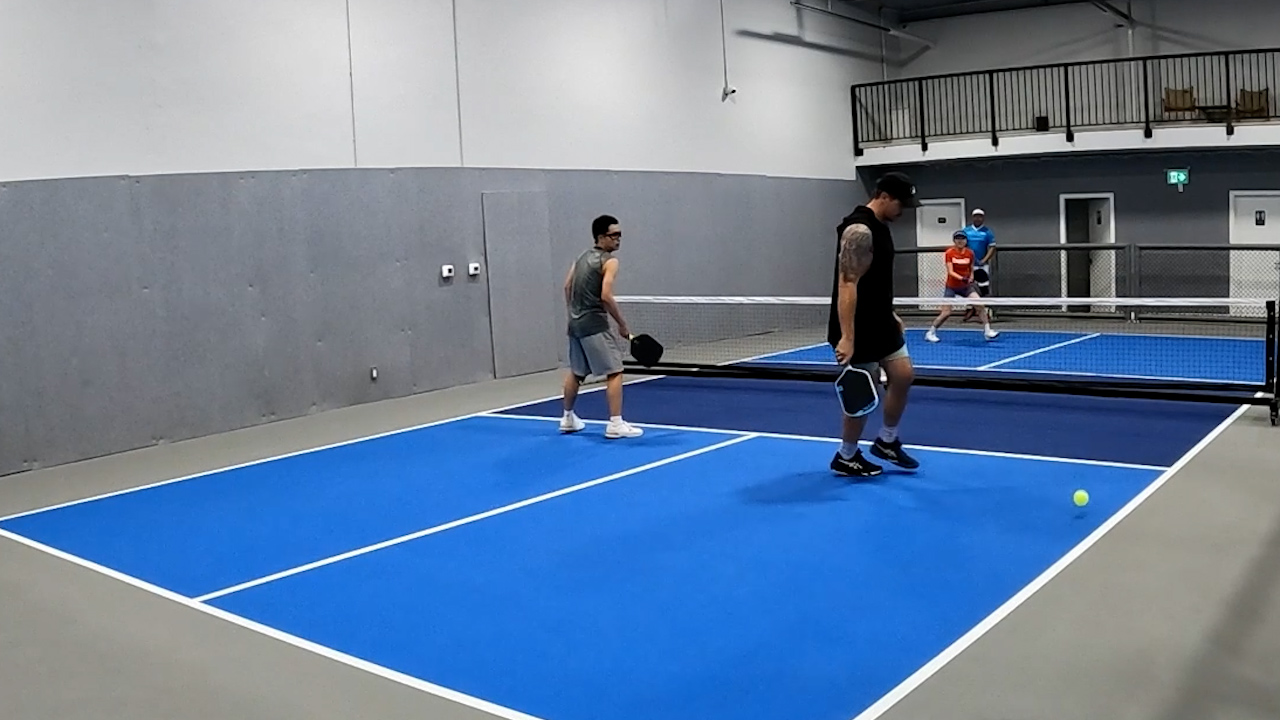
2. The Tweener Drive (The Counter-Attack)
If you notice your opponents stayed back at their baseline after hitting the lob, you have the green light to be aggressive. By snapping your wrist hard with an open paddle face, you can drive a fast, tailing ball right down the middle of the court.
A Quick Reality Check: Is a tweener always the highest-percentage shot? Absolutely not. If you have the time to completely overrun a ball, turn around, and hit a standard drop shot, you should probably do it. But when you are pressed for time and need a last-resort save, the tweener is an elite tool to keep the point alive.
Tips to Practice (Without Hitting Your Shins)
If you want to start practicing this on an open court, don’t start by having a partner launch deep lobs at you right away.
- The Self-Drop: Stand in “No Man’s Land” (the transition area), hold a ball out in front of you, drop it, run past it, and practice the through-the-legs flick from a stationary start. This builds the muscle memory for paddle-to-ball spatial awareness.
- The Partner Toss: Have a friend stand at the net and gently toss balls over your head so you can practice tracking the trajectory over your shoulder while building your stride timing.
Mastering this shot takes patience, a little bit of athleticism, and the willingness to look a bit goofy during your first few practice sessions. But the first time you pull off a clean tweener drop in a recreational game, watching your opponents look at each other in utter disbelief makes every missed practice shot completely worth it.